

Dhamma sphere : ค้นหาหนังสือธรรมะ หน้า 3 / 7
หน้าหนังสือทั้งหมด
53
Understanding Dhamma and Nibbāna in Buddhism
With regard to dhamma as the 'essence' of the Buddha and Arhat disciples, however, it may be more appropriate to refer to 'Nibbāna,' for once they have attained Buddhahood and Arhatship their spiritua
This text explores the concept of dhamma in relation to the Buddha and Arhat disciples, particularly the notion of Nibbāna as the essence of their enlightenment. It argues that dhamma, especially in t
61
Exploring the Concept of Dhammakaya
First, as a *kammadhāra* compound, the translation of the term *dhammākāya* will be ‘the body that is transcendental (lokuttara) dhamma’ or ‘the body that is Nibbāna.’ This gives a similar sense as th
The term Dhammakaya can be viewed in two ways: as a kammadhāra compound translated to mean 'the body that is transcendental dhamma' or as a tappurisa compound meaning 'body pertaining to transcendenta

57
การสัมภาษณ์นักท่องเที่ยวชาวอังกฤษ
An interview was conduct and edited
by suwanee srisopa
A BUDDHIST
VISITOR FROM
ENGLAND
"Practising Dhamma
brings you happiness."
In practising Dhamma, one will
certainly get in return the insight know
ENGLAND "Practising Dhamma brings you happiness." In practising Dhamma, one will certainly get in return the insight know- ledge known particularly to oneself. This signifies that after Dhamma study,
134
The Importance of Meditation in Buddhism
Meditation is the focussing of the mind on a single object and abiding in a single mood without distraction or restlessness, or being caught up in external influences on mood. Meditation is thus of gr
Meditation is central to Buddhist practice, allowing individuals to focus the mind on a single object, leading to the cultivation of virtues and deeper levels of awareness. The attainment of the five
220
Exploring the Path to Enlightenment in Buddhism
101; enlightenment mechanism, chanting, Dhammacakkapavattana explained by Dhammakaya 111; Sutta 10-11, 209-16 knowledge arising to reach enlightenment 140-1; practice 94, metaphors: dog and lion 94; g
This text delves into various aspects of Buddhism, focusing on the mechanisms of enlightenment through chanting and the Dhammacakkapavattana Sutta. The practices necessary for attaining enlightenment
113
Discovering Inner Transcendental Bodies
… discovered that when the mind is relaxed in a standstill state, while resting at the center of the Dhamma Sphere, inner transcendental bodies will emerge, one after another: from coarse human body to subtle human…
…text discusses the emergence of inner transcendental bodies through relaxation at the center of the Dhamma Sphere. As the mind achieves a state of calm and stillness, one can transition through various forms, from…
75
Dhamma Talk with Luang Por at the Peace Revolution Conference
Meeting #13
04 March 2010 – International Buddhist Association Building
Luang Por has agreed to meet with the members of the Peace Revolution Conference for a Dhamma talk and a question/answer sessio
In a gathering at the International Buddhist Association, Luang Por leads a Dhamma talk addressing meditation experiences and the relationship between body, mind, and Dhamma. Observing attendees, he e
32
The Complete Teacher: Integrating Academic Excellence and Dhamma in Education
Chapter 3
directly and indirectly so that students can understand and learn thoroughly. This requires trainers who have not only the first level of wisdom, which is from memorization, but also from t
บทนี้อธิบายถึงความสำคัญของครูในฐานะที่เป็นแบบอย่างและการผสมผสานความรู้ทางวิชาการเข้ากับธรรม เพื่อช่วยให้นักเรียนเติบโตเป็นคนดี เนื้อหายังกล่าวถึงระดับความเข้าใจที่พระพุทธเจ้าสอนเกี่ยวกับชีวิต สี่ขั้นต
43
Receiving Guests with Compassion and Dhamma
40. RECEIVING GUESTS
Receiving guests who inquire for your help is not easy. We must learn the proper way to do it. Although we must cater to them, we must also maintain our moral nature, especially
Receiving guests seeking guidance can be challenging. It is essential to cater to them while upholding our moral nature and Dhamma. Guests often share their struggles, which can distract us from our p
44
The Transformative Power of Meditation
ERVICE
I couldn't help thinking a lot, sometimes I kept
thinking until midnight. One sleepless night, I decided
to try meditating. I just sat and let time go by, waiting
for myself to feel sleepy. I d
The narrative illustrates a woman's journey through meditation, revealing how it leads her to inner peace, emotional stability, and a better understanding of herself. Initially sleepless and contempla
152
The Path to Enlightenment through Meditation
silently and continuously in the mind. If you are not sure about the location of the center of the body, just know that anywhere in the area of your abdomen will do. Don't be disappointed if you find
This text discusses the process of meditation, focusing on the abdominal area as the center of the body. It acknowledges the challenge of a wandering mind in beginners and emphasizes the importance of

89
ธาตุทั้งห้าในดวงธรรม
ง บ อ ง เ ล็ ก
I
(...พอคุณวางใจหยุดที่ศูนย์กลางกายได้ ดวงธรรมก็จะปรากฏขึ้นทันที...)
...in this sphere of Dhamma, each of the five elements is centred in a small sphere...
(...ภายในดวงธรรมนี้ มีดวงกลมใ
I (...พอคุณวางใจหยุดที่ศูนย์กลางกายได้ ดวงธรรมก็จะปรากฏขึ้นทันที...) ...in this sphere of Dhamma, each of the five elements is centred in a small sphere... (...ภายในดวงธรรมนี้ มีดวงกลมใสเล็ก ๆ เป็นดวง
222
Understanding Dhammakāya and Defilements in Meditation
deep meditation 114
defilement 122: different, for each
inner body 135; of Angelic Body 135;
of Dhammakāya Anāgāmi 137; of
Dhammakāya Gotrabhu 136; of
Dhammakāya Sakidāgāmi 136,
137; of Dhammakāya Sot
The text provides an in-depth examination of the Dhammakāya concept, explaining various levels such as Dhammakāya Anāgāmi, Gotrabhu, and Sakidāgāmi. It discusses the nature of defilements and how arah
54
Raising Smart and Virtuous Children
utilize the four requisites, how they work, and how they
conduct their daily activities.
Parents can instill wholesomeness, intelligence, and
compassion towards others by teaching their children resp
This text discusses the importance of teaching children the four requisites—respect, discipline, and endurance. It emphasizes the balance between worldly wisdom and Dhamma wisdom, highlighting how bot
100
The Dhammakāya Verse: A Lan Na Thai Manuscript
The Dhammakāya Verse:
a Lan Na Thai manuscript
Kitchai Urkasem
This article is a report on research undertaken with the support of the 60th Dhamma chai Education Foundation (DEF) on a palm leaf manu
This article discusses research supported by the 60th Dhamma chai Education Foundation on a palm leaf manuscript titled Dhamma kāya from northern Thailand's Lan Na region. Undated, it is believed to h
110
Understanding the Dhamma Body and Its Levels
reach the station, from there we take the train to the airport and eventually take the aeroplane that will take us to our destination.
All the various inner spheres and bodies all the way from the Phy
This text delves into the concept of the Dhamma Body, highlighting its intricate structure composed of multiple layers, each representing a different level of spiritual refinement. Luang Phaw Wat Pakn
16
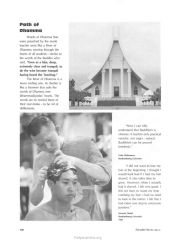
เส้นทางแห่งธรรม
Path of
Dhamma
Words of Dhamma that
were preached by the monk
teacher were like a River of
Dhamma running through the
hearts of all students - similar to
the words of the Buddha who
said, "Even as a l
Path of Dhamma Words of Dhamma that were preached by the monk teacher were like a River of Dhamma running through the hearts of all students - similar to the words of the Buddha who said, "Even as a l

39
Dhamma.NET และการสื่อสารในยุคปัจจุบัน
เรื่องเด่น
น.พ.ฉัตรชัย ศรีบัณฑิต
3 DHAMMA NET: The world of Dhamma - Microsoft Internet Explorer
File Edit View Favorites Tools Help
L
Back
Forward Stop Refresh Home Search Favorites History
Address h
เรื่องเด่น น.พ.ฉัตรชัย ศรีบัณฑิต 3 DHAMMA NET: The world of Dhamma - Microsoft Internet Explorer File Edit View Favorites Tools Help L Back Forward Stop Refresh Home Search Favorites History Address h

187
สูตรศักดิ์สิทธิ์ในการสอนธรรม
For example, if there were statements about constructing a
Dhamma Hall or a monk's shelter soon, then this must happen.
In short, the temple must produce results as soon as it can.
Thus, the first sac
For example, if there were statements about constructing a Dhamma Hall or a monk's shelter soon, then this must happen. In short, the temple must produce results as soon as it can. Thus, the first sac
125
Understanding Key Buddhist Concepts
"Fools" (palay): spiritually defective people. A fool is someone wicked, weak, or feeble in a moral sense. His discretion is faulty, not knowing right from wrong, good from bad. A fool is one who give
This content delves into various Buddhist concepts such as 'fools'—spiritually defective individuals whose actions reflect moral weakness. It explains that heaven in Buddhism comprises six levels prov